
The part nobody talks about on International Women’s Day
How a four day retreat cracked open a conversation we should have been having a long time ago.

A few days before International Women’s Day, I was sitting with a group of women I hadn’t known a year ago and in some cases, hadn’t known a week ago, feeling more like myself than I had in a long time.
It didn’t happen by accident. But I also didn’t see it coming.
A member of our BONDE community said something to me leading up to the retreat that made me laugh out loud the second she said it.
“Before this, you couldn’t have paid me to do something like this. Leave my family for multiple days for some kind of networking event. And here I am… excited for it, buying new clothes for it, anticipating the exhale of it. And choosing to pay for it…”
Same. Completely same.
I was always the person who dreaded anything like this. Networking events, work trips, leaving my family for more than a day. Going anywhere with strangers where I’d have to make small talk and grin and bear it until I could get back to the hotel room and tell my husband I was ready to go home. While looking up earlier flights.
And without realizing it, here I was. Planning it. Willingly and excited. I didn’t even realize it until she said it out loud.
Here’s what I think is actually going on. And I think it happens to a lot of women without us ever stopping to recognize it.
We carry so much and so consistently, that we stop noticing we’re carrying it. The mental tabs are open 24 hours a day whether we want them to be or not. The to-do list doesn’t clock out when we do. We’re running the household logistics, the work priorities, the emotional calendar of everyone around us. All at the same time. Usually in the background. And usually without being asked.
Experts call this the mental load. Not just doing the tasks but managing the awareness that the tasks exist. Knowing the pediatrician appointment needs to be scheduled, that we’re almost out of something, that a friend is going through something and hasn’t been checked on. It’s not the work itself… it’s the constant open-tab hum of it.
Here’s my version of it: my husband does so much. Genuinely. Many times he’s the 60 to my 40. But even when he’s doing the 60, actually physically doing it, I’m mentally right there with him. More milk picked up, check. Son dropped off with the right coat so the teachers know it’s his, check. Garbage on the curb Wednesday night, check. He completed the task but I still tracked it anyway. Not because he asked me to. But because I can’t help it.
And I don’t think this is unique to me. Most women reading this probably just nodded.
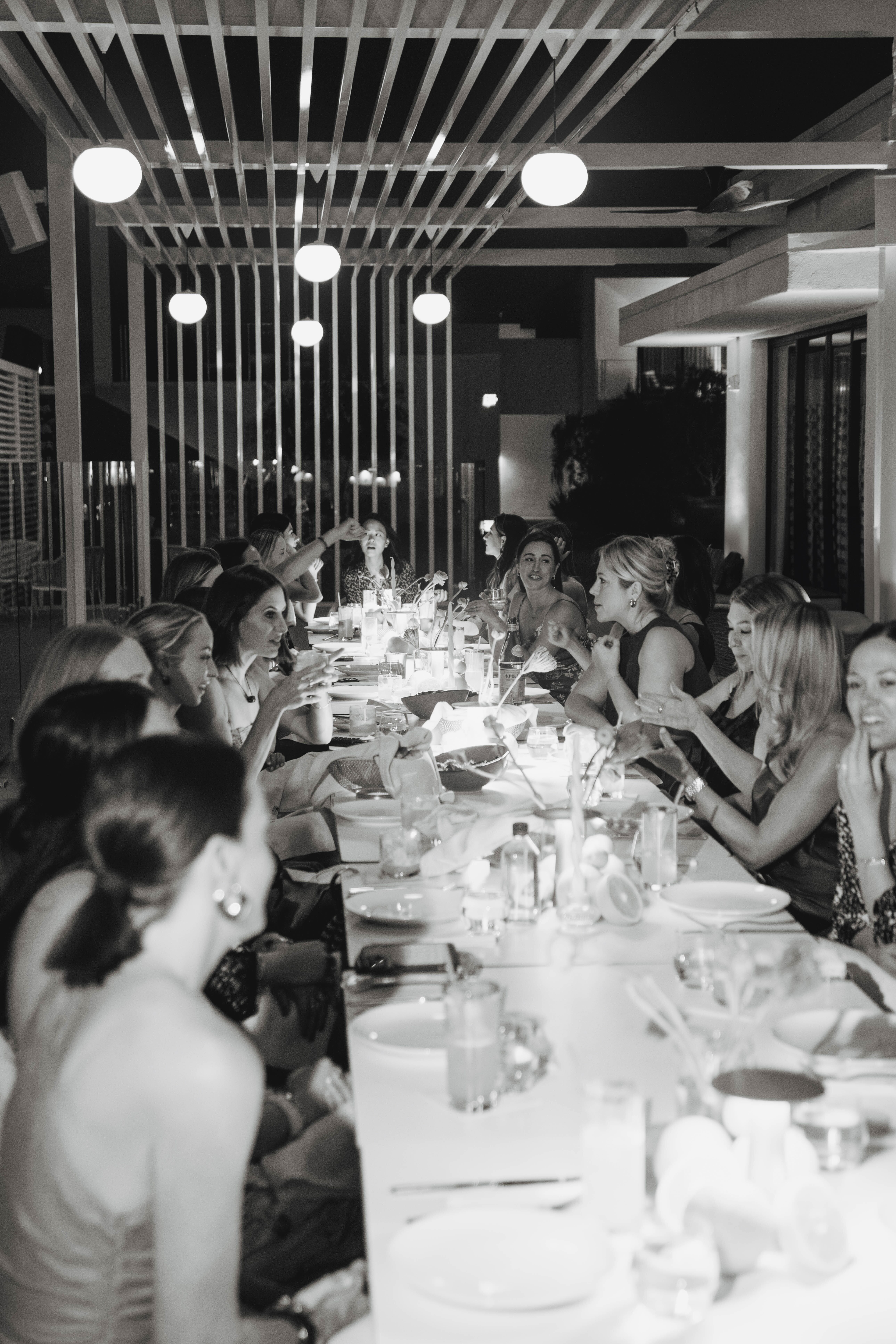
An example of this happened before the retreat even started.
A group of us were laughing around the pool about how we’d each prepared to leave. Almost every mother had done the same thing: stayed up late making sure the laundry was done, organized meals for days (shoutout to Little Spoon for helping us here), written out detailed instructions nobody asked for, outlined every possible scenario so that life at home could continue without a hiccup.
And then we got on the plane quietly annoyed and exhausted that we’d had to do all of that just to feel like all the boxes were checked.
The wildest part? We gave ourselves those invisible boxes. Our partners didn’t ask for any of it. They really didn’t need it. But we did it anyway. Because somewhere in us, we felt we needed to earn the permission to go. We needed to know everything was taken care of before we could justify taking care of ourselves.
That’s not love or even responsibility. That’s conditioning.
The part nobody talks about on International Women’s Day.
This isn’t just about women. It’s about what we’ve all inherited.
We watched prior generations divide the world into two jobs: the home-job and the job-job. Women naturally, and through forced societal norms took the home job, and then added the job-job on top. Men took the job-job and weren’t conditioned to think about the home-job at all. Not because they don’t care, but because nobody taught them to track it the way we do.
So when a guy leaves for a work trip or a golf weekend, his mental checklist is: what do I need to pack? He wasn’t conditioned to ask: have I set the home up for success before I go?
And when a mom leaves, she gets asked, and often times by others: who’s taking care of the kids?
The answer: their dad. The other fifty percent of their parent who is entirely capable and genuinely excited for the quality time. And we need to say that more. Because painting this as a burden or suggesting that dads can’t handle it sends the wrong message in the other direction.
The whole dynamic needs a rebrand. A rebalance.
The goal isn’t for women to get better at stealing away for a few days to recover from a load that never gets redistributed. That’s just a pressure valve. The real shift happens when the mental load is actually shared.
Which is exactly why what happened at the retreat mattered.
What makes BONDE different from every “networking event” I’d ever dreaded was that nobody asked what you’d accomplished.
From the moment you shake the first hand, the question is never what do you do for work? or how accomplished are you? It’s simpler: how are you really? what made you decide to show up for you?
No positioning. No resume comparison. Just women showing up as honestly as they could from the very first conversation.
For women who are used to being in the driver’s seat, in business, at home, everywhere, that kind of intentional letting go is both necessary and honestly super uncomfortable because it’s unfamiliar. The feeling of being somewhere without the full itinerary. Of not being needed for a few days. Of stepping away from the version of yourself that holds everything together.
And then slowly… sometimes over a meal, or around a pool, or in a conversation you didn’t expect to have while hiking, something loosens. The tabs start closing. You hear yourself think. You remember what you actually sound like when nobody needs anything from you.
That’s where quiet confidence lives. Not in the performing of it. But in the space where it finally has room to surface.
Women’s History Month is full of recognition for what women have built, carried, survived, and achieved. All of it deserved. But what I keep coming back to this year is quieter than that.
I keep thinking about the reframe.
The bigger question underneath it: what would it look like if we stopped treating the mental load as a personality trait of capable women and started treating it as a structural problem worth actually solving? What if the goal wasn’t to help women “rest better” within the current system, but to question why the system is set up this way at all?
That’s the conversation I want to keep having. Around the table, in the comments, and everywhere else.
We don’t have to earn the exhale. But we do deserve a world where we’re not asked to.
Tables Ready is an open conversation with my readers and a chance for me to get to know you too. If this resonated or reminded you of your own version of this, I’d love to hear about it in the comments or message me in my inbox.
Wow I love this idea of a reframe so much! Thanks for sharing!
100% agree with all of this. Cheers to the reframe!